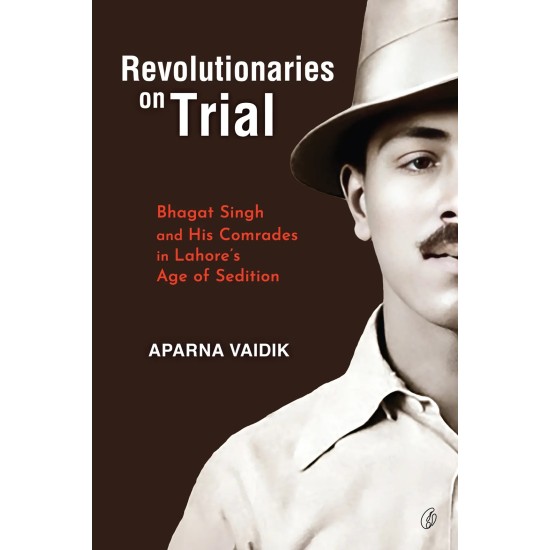
- Writer: Aparna Vaidik
- Category: English
- Pages: 550
- Stock: In Stock
- Model: STP-15676
Revolutionaries on Trial is a groundbreaking new study of the infamous Lahore Conspiracy Case and its principal martyrs-Bhagat Singh, Sukhdev, and Rajguru who belonged to the Hindustan Socialist Republican Army (HSRA). The trial was named after the city of Lahore where it was booked and held from 23 July 1929 in Lahore Central Jail. On 7 October 1930, the judge pronounced the young men guilty of conspiring and waging a war against the British crown. Bhagat Singh, Sukhdev, and Rajguru whom the Indian public believed to be innocent at the time were sentenced to be hanged and others received varying jail sentences.The book examines the elaborate performances of four sets of actors-the colonial state as the plaintiff, the revolutionaries as the defendants, witnesses for the prosecution, and the Indian press and publics as spectators-each with their own motivations, aspirations, and a view of the desired outcome of the trial. It further captures the extraordinary canvas of the trial which was staged not just in a courtroom but across multiple sites-offices of the investigation officers, legislative assembly, government offices, jails, courtroom, streets, printing presses, newspaper establishments, coffee houses, meeting rooms, and universities across North India.Even as the book examines the history of the dramatic trial, it asks new questions: why did the colonial state bother to put the revolutionaries on trial despite the vast repertoire of violence at its disposal? What more was there to the revolutionaries' trial strategy other than using the process for propaganda? Is it possible to write a history of nationalism that incorporates acts of collaboration (e.g., spying, informing, perfidy, and denunciation) without the implicit moral judgement and destructive potential embodied in the term? In what way did the trial shift the public perception about the revolutionaries, if at all? This book draws on rare archival material the Trial records in Lahore Pakistan and National Archives of India, Oral History interviews of surviving revolutionaries, their memoirs, letters, and diaries, the Indian and British newspaper records, Legislative Assembly Debates, and police investigation records.The book is over decade's worth of labour, three field trips to Lahore (Pakistan), combing through archives and libraries spread out in different countries. Lucidly written and grounded in impeccable scholarship, historian Aparna Vaidik brings to vivid life the people and events of a trial that left an indelible imprint on the history of nationalism and revolution in India.
About Aparna Vaidik
Aparna Vaidik is Professor of History at Ashoka University. Educated at St. Stephen's College, Cambridge University and Jawaharlal Nehru University, she has previously taught at Georgetown University, Washington DC and University of Delhi.Prof. Vaidik is author of 4 books: Revolutionaries on Trial: Sedition, Betrayal and Martyrdom (Aleph, 2024), Waiting for Swaraj: Inner Lives of Indian Revolutionaries (CUP, 2022), My Son's Inheritance: Secret History of Lynching and Blood Justice in India (Aleph, 2020) and Imperial Andamans: Colonial Encounter and Island Histories (Palgrave Macmillan, 2010).She is also a recipient of research grants from the British Academy, Andrew Mellon Foundation, Indian Council for Historical Research, and Charles Wallace India Trust. She has been teaching courses on historical methods and psychoanalysis, Contemporary Indian History, Narrative History-writing. She is also involved in public history and pedagogy initiatives and runs a Trust that houses a community library that has 3000+ members.
| Book Attributes | |
| Pages | 550 |