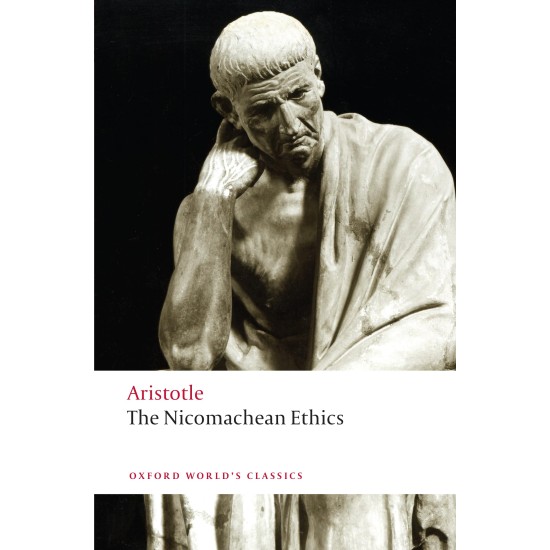
In the Nicomachean Ethics, Aristotle sets out to examine the nature of happiness. He argues that happiness consists in ‘activity of the soul in accordance with virtue’, for example with moral virtues, such as courage, generosity and justice, and intellectual virtues, such as knowledge, wisdom and insight. The Ethics also discusses the nature of practical reasoning, the value and the objects of pleasure, the different forms of friendship, and the relationship between individual virtue, society and the State. Aristotle’s work has had a profound and lasting influence on all subsequent Western thought about ethical matters.
J. A. K. Thomson's translation has been revised by Hugh Tredennick, and is accompanied by a new introduction by Jonathan Barnes. This edition also includes an updated list for further reading and a new chronology of Aristotle’s life and works.
About Aristotle
Aristotle was an ancient Greek philosopher and scientist, who pioneered many contemporary disciplines. Together with Plato, Aristotle is regarded as a founding figure of Western philosophy. He was born in 384 BCE in Stagira, Chalcidice, Greece. His works have served as the basis for many philosophical movements including Renaissance, Reformation and the Enlightenment. Aristotelian thought also influenced Medieval Islamic philosophy. A lot of jargon, terminology and lexicon in philosophy has been borrowed from Aristotle's work.His intellectual range was extensive and included logic, history, ethics, biology, chemistry, political theory, psychology, metaphysics, philosophy of science, and philosophy of mind. His work remained unsurpassed in zoology until the 19th century. His writings on metaphysics and political theory are still debated in contemporary philosophical and political studies. He died in 322 BCE, in Chalcis, Euboea.
| Book Attributes | |
| Pages | 278 |